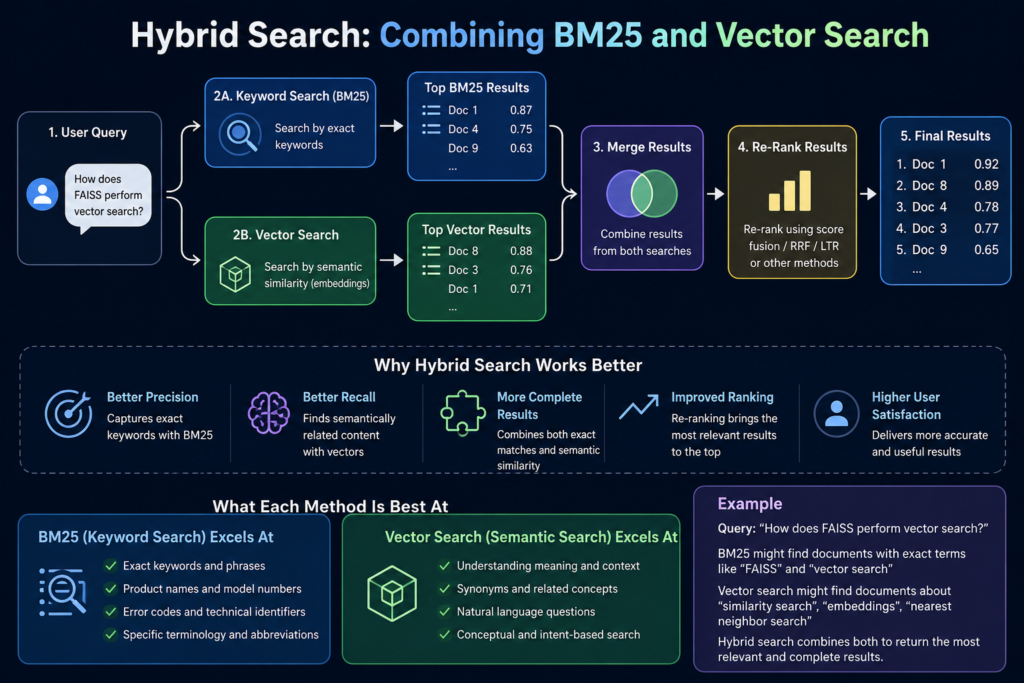
🔎 What Is Hybrid Search?
Hybrid search is a retrieval approach that combines traditional keyword search with vector-based semantic retrieval.
Instead of relying on a single search method, hybrid search uses both techniques to improve relevance and retrieval accuracy.
This allows search systems to benefit from the strengths of each approach while reducing their individual weaknesses.
🧠 Why Hybrid Search Matters
Keyword search and semantic retrieval solve different problems.
Keyword search excels at finding exact terms, product names, codes, and highly specific phrases.
Semantic retrieval excels at understanding meaning, intent, and conceptual similarity.
By combining both methods, retrieval systems can provide more complete and accurate search results.
⚡ The Best of Both Worlds
A hybrid approach can:
- improve retrieval accuracy
- reduce missed results
- increase recall
- improve precision
- handle both exact matches and semantic relationships
This makes it particularly useful for modern AI applications.
📄 Where Hybrid Search Is Used
Hybrid retrieval is increasingly common in:
- RAG systems
- enterprise search platforms
- customer support systems
- document retrieval applications
- knowledge management solutions
These environments often require both keyword matching and semantic understanding.
🚀 Growing Importance in AI
As retrieval systems become more sophisticated, many organizations are moving away from purely keyword-based or purely semantic approaches.
Instead, hybrid search is becoming a standard architecture for production AI systems because it balances precision, relevance, and scalability.
🎯 Practical Insight
Hybrid search combines the precision of keyword retrieval with the flexibility of semantic retrieval, making it one of the most effective approaches for modern information retrieval systems.
🧠 Understanding BM25 Search
BM25 is one of the most widely used ranking algorithms in traditional information retrieval systems.
It is designed to identify documents that contain query terms and rank them according to their relevance.
Many search engines, document management systems, and enterprise search platforms rely on BM25 as a core retrieval method.
🔎 How BM25 Works
When a user submits a query, BM25 evaluates documents based on factors such as:
- keyword occurrence
- keyword frequency
- document length
- term importance
Documents containing highly relevant terms receive higher scores and are ranked closer to the top of the results.
Unlike simple keyword matching, BM25 uses statistical weighting to improve ranking quality.
⚡ Why BM25 Is Effective
BM25 performs exceptionally well when users search for:
- product names
- model numbers
- error codes
- technical terms
- exact phrases
In these situations, precise keyword matching is often more important than semantic similarity.
This is one reason BM25 remains widely used despite advances in AI retrieval technologies.
📄 Example
Consider the query:
“FAISS vector database”
A BM25-based system will prioritize documents containing those exact terms.
Documents that repeatedly mention “FAISS” and “vector database” will generally rank higher than documents that discuss similar concepts without using those specific words.
🚀 Strengths of BM25
BM25 offers several advantages:
- fast retrieval
- interpretable rankings
- strong exact-match performance
- low computational cost
- mature ecosystem support
These strengths make it a reliable component in many retrieval systems.
⚠️ Limitations of BM25
BM25 does not understand meaning.
For example, a query such as:
“How does AI find relevant documents?”
may not retrieve content focused on:
- semantic retrieval
- embeddings
- vector search
- similarity search
if those exact words do not appear in the document.
This limitation becomes more apparent when users phrase questions in different ways.
🎯 Practical Insight
BM25 remains one of the strongest solutions for exact keyword retrieval.
However, its inability to understand semantic relationships is one of the primary reasons modern retrieval systems increasingly combine BM25 with vector-based retrieval in hybrid search architectures.
🚀 Understanding Vector Search
Vector search is a retrieval method that finds information based on meaning rather than exact keyword matching.
Instead of comparing words directly, vector search compares numerical representations of documents and queries known as embeddings.
This allows retrieval systems to identify conceptually related content even when different terminology is used.
🧠 How Vector Search Works
A typical vector retrieval workflow includes:
- converting documents into embeddings
- storing embeddings in a vector database
- converting user queries into embeddings
- performing similarity search
- returning the nearest matches
Because both documents and queries exist in the same vector space, the system can measure semantic similarity mathematically.
🔎 Understanding Meaning
One of the biggest advantages of vector search is its ability to understand relationships between concepts.
For example, a query such as:
“How do AI systems retrieve information?”
may successfully retrieve documents discussing:
- semantic search
- embeddings
- vector databases
- retrieval pipelines
even if the exact query words never appear in the document.
This makes retrieval much more flexible than traditional keyword search.
📄 Example
Imagine two documents:
Document A:
“FAISS is a vector database technology.”
Document B:
“Embeddings enable semantic retrieval in AI systems.”
A query such as:
“How does AI find similar documents?”
may retrieve both documents because they are conceptually related to the user’s intent.
A keyword-only system could miss some of these connections.
🚀 Strengths of Vector Search
Vector search provides several important advantages:
- understands semantic meaning
- handles synonyms naturally
- supports natural language questions
- improves retrieval flexibility
- works well with AI-generated content
These strengths have made vector search a core component of modern AI retrieval systems.
⚠️ Limitations of Vector Search
Despite its advantages, vector search is not perfect.
It may struggle with:
- exact product names
- serial numbers
- model identifiers
- error codes
- highly specific keywords
For example, a query such as:
“RTX 5090”
often requires exact matching rather than semantic understanding.
This is where traditional keyword retrieval can outperform vector search.
🎯 Practical Insight
Vector search excels at understanding meaning and user intent, but it is not always the best solution for exact-term retrieval.
This complementary relationship between keyword and semantic retrieval is one of the main reasons hybrid search has become increasingly popular in modern AI systems.
⚖️ Why Pure Keyword Search Is Not Enough
Keyword retrieval remains highly effective for exact matching scenarios, but modern information retrieval systems face challenges that traditional keyword search was not designed to solve.
As document collections grow and user queries become more natural, relying exclusively on keyword matching often leads to incomplete or less relevant results.
🧠 Users Do Not Always Use the Right Terms
One of the biggest challenges is that users frequently describe the same concept using different words.
For example, a user may search for:
“How does AI find relevant information?”
while the document uses terms such as:
- semantic retrieval
- vector search
- embeddings
- document ranking
A keyword-only system may fail to connect these related concepts.
🔎 Synonyms and Related Concepts
Different authors often use different terminology to describe similar ideas.
Examples include:
- AI assistant vs virtual assistant
- document retrieval vs information retrieval
- semantic search vs vector search
Keyword search treats these as separate terms, even when they describe closely related concepts.
📄 Natural Language Queries
Modern users increasingly interact with systems using complete questions rather than short keyword phrases.
Examples include:
- “How do RAG systems retrieve documents?”
- “What is the difference between embeddings and vectors?”
- “How does semantic retrieval work?”
These queries often require understanding intent rather than matching exact words.
⚡ Missing Relevant Information
A document may contain highly relevant information without containing the exact query terms.
As a result:
- relevant documents may be missed
- recall may decrease
- users may receive incomplete results
This becomes especially problematic in large knowledge bases.
🚀 Challenges in AI Applications
Modern AI systems often require:
- contextual understanding
- intent recognition
- semantic matching
- retrieval across large datasets
Traditional keyword retrieval alone is rarely sufficient for these requirements.
This is one reason retrieval-augmented generation systems increasingly rely on semantic retrieval techniques.
🎯 Practical Insight
Keyword search remains extremely valuable for exact matches, product names, codes, and technical identifiers.
However, modern retrieval systems often need to understand meaning as well as words, which is why keyword retrieval alone is rarely enough for advanced AI and enterprise search applications.
🔄 Why Pure Vector Search Is Not Enough
Vector search has transformed modern retrieval systems by enabling semantic understanding and intent-based retrieval.
However, despite its strengths, vector search is not a perfect replacement for traditional keyword retrieval.
In many real-world applications, relying solely on vector search can introduce its own challenges.
🧠 Exact Matches Matter
Some queries depend heavily on precise terms.
Examples include:
- product names
- serial numbers
- error codes
- API names
- software versions
A user searching for:
“GPT-4o-mini”
or
“Error 0x80070057”
typically expects exact matches.
In these situations, keyword retrieval often performs better than semantic similarity alone.
🔎 Semantic Similarity Can Be Too Broad
Vector retrieval is designed to find conceptually related information.
While this is often beneficial, it can sometimes return content that is similar but not sufficiently precise.
For example, a query about:
“FAISS”
may retrieve content discussing:
- vector databases
- embeddings
- semantic retrieval
even when the user specifically needs information about FAISS itself.
This can reduce precision.
📄 Important Keywords Can Be Lost
Embeddings compress information into vector representations.
During this process, some highly specific details may become less influential.
Examples include:
- version numbers
- identifiers
- product codes
- technical references
These details are often critical in enterprise and technical search environments.
⚡ Ranking Challenges
Vector search retrieves documents based on similarity scores.
However, the most semantically similar document is not always the most useful document.
Users may prefer content that:
- contains exact query terms
- references a specific product
- includes a precise answer
- matches organizational terminology
Similarity alone does not guarantee relevance.
🚀 Enterprise Search Requirements
Many organizations require retrieval systems that can handle both:
- exact keyword matching
- semantic understanding
A search platform that ignores either requirement may fail to meet user expectations.
This is particularly important for:
- technical documentation
- support knowledge bases
- legal content
- product catalogs
⚖️ The Need for Balance
Keyword retrieval and vector retrieval solve different retrieval problems.
One focuses on exact terms.
The other focuses on meaning.
Modern retrieval systems often achieve the best results when both signals contribute to ranking decisions.
🎯 Practical Insight
Vector search is excellent at understanding intent, but it is not always the best solution for exact-match retrieval.
This limitation is one of the main reasons hybrid search architectures combine BM25 and vector retrieval instead of relying on either approach alone.
🎯 How Hybrid Search Works
Hybrid search combines the strengths of keyword retrieval and vector retrieval within a single search workflow.
Instead of choosing between BM25 and vector search, a hybrid system uses both methods and merges their results to improve overall retrieval quality.
This approach helps balance exact matching with semantic understanding.
🧠 Step 1: Execute a Keyword Search
The first retrieval path uses BM25 or a similar keyword-ranking algorithm.
This search identifies documents that contain:
- exact query terms
- product names
- technical identifiers
- specific phrases
Documents receive scores based on keyword relevance.
🔎 Step 2: Execute a Vector Search
At the same time, the system performs vector retrieval.
The query is converted into an embedding and compared against stored document embeddings.
This search identifies content that is:
- semantically related
- conceptually similar
- relevant to user intent
even when exact keywords differ.
📄 Step 3: Merge the Results
The retrieval system combines results from both search methods.
A document may rank highly because:
- it contains exact keywords
- it is semantically relevant
- or both
This allows the system to capture information that would be missed by either method individually.
⚡ Step 4: Re-Rank the Results
Many hybrid retrieval systems apply additional ranking logic.
Common approaches include:
- weighted score fusion
- reciprocal rank fusion (RRF)
- learning-to-rank models
- AI-based re-ranking
These techniques help determine which documents should appear first.
🚀 Example
Consider the query:
“How does FAISS perform vector search?”
BM25 may prioritize documents containing:
- FAISS
- vector search
Vector retrieval may identify documents discussing:
- similarity search
- embeddings
- nearest-neighbor retrieval
A hybrid system can combine both signals and return a more complete set of results.
⚖️ Why It Works Better
Hybrid retrieval often improves:
- precision
- recall
- ranking quality
- user satisfaction
Keyword search contributes exact matching.
Vector search contributes semantic understanding.
Together, they create a stronger retrieval system.
🎯 Practical Insight
The most effective hybrid search systems do not replace keyword retrieval or vector retrieval.
Instead, they combine both approaches to leverage the strengths of each, producing more accurate and reliable search results across a wide range of use cases.
📊 BM25 vs Vector Search vs Hybrid Search
Each retrieval approach has unique strengths and weaknesses.
Understanding these differences helps explain why many modern AI systems are moving toward hybrid retrieval architectures.
🧠 Feature Comparison
| Feature | BM25 Search | Vector Search | Hybrid Search |
|---|---|---|---|
| Exact Keyword Matching | Excellent | Limited | Excellent |
| Semantic Understanding | Limited | Excellent | Excellent |
| Handles Synonyms | Weak | Strong | Strong |
| Product Names & Codes | Excellent | Moderate | Excellent |
| Natural Language Queries | Moderate | Excellent | Excellent |
| Retrieval Precision | High | High | Very High |
| Retrieval Recall | Moderate | High | Very High |
| RAG Compatibility | Good | Excellent | Excellent |
| Enterprise Search | Good | Good | Excellent |
| Overall Flexibility | Moderate | High | Very High |
🔎 BM25 Search
Best for:
- exact keywords
- technical identifiers
- product names
- serial numbers
- error codes
Main advantage:
- highly accurate exact-match retrieval
Main limitation:
- limited understanding of semantic meaning
🚀 Vector Search
Best for:
- semantic retrieval
- natural language questions
- concept discovery
- intent-based search
Main advantage:
- understands relationships between concepts
Main limitation:
- can miss highly specific keyword requirements
⚖️ Hybrid Search
Best for:
- enterprise search
- AI assistants
- RAG pipelines
- technical documentation
- knowledge management systems
Main advantage:
- combines exact matching with semantic understanding
Main limitation:
- slightly higher implementation complexity
📄 Which Approach Should You Choose?
The answer depends on the application.
Choose BM25 when:
- exact matches are critical
- keyword precision is the primary requirement
Choose Vector Search when:
- semantic understanding is the primary goal
- users frequently ask natural language questions
Choose Hybrid Search when:
- both precision and semantic relevance matter
- search quality is a top priority
- the system must support diverse query types
🎯 Practical Insight
For many modern AI applications, hybrid search delivers the strongest overall retrieval performance because it combines the strengths of both BM25 and vector retrieval while minimizing their individual weaknesses.
🤖 Hybrid Search in RAG Pipelines
Many modern RAG systems use hybrid retrieval rather than relying exclusively on vector search.
While semantic retrieval is extremely powerful, production environments often require a combination of exact matching and semantic understanding to achieve the best results.
This is where hybrid search becomes particularly valuable.
🧠 The Role of Retrieval in RAG
A RAG pipeline typically includes:
- document ingestion
- chunking
- embedding generation
- retrieval
- answer generation
The quality of retrieved information directly affects the quality of generated answers.
If relevant information is not retrieved, the language model cannot use it.
🔎 Why Vector Search Alone Is Sometimes Insufficient
Vector retrieval works well for:
- semantic similarity
- intent understanding
- natural language queries
However, it may struggle with:
- product identifiers
- software versions
- model names
- exact technical terms
These details are often important in enterprise knowledge bases and technical documentation.
📄 Why BM25 Alone Is Sometimes Insufficient
Keyword retrieval excels at exact matching.
However, it may miss documents that:
- use different terminology
- contain synonyms
- explain concepts using alternative wording
This can reduce recall and limit the effectiveness of retrieval.
⚡ Hybrid Retrieval Improves Context Quality
By combining keyword and semantic signals, hybrid retrieval often produces:
- more relevant context
- better document coverage
- improved retrieval precision
- higher recall
This increases the likelihood that useful information reaches the language model.
🚀 Enterprise RAG Applications
Hybrid retrieval is commonly used in:
- internal knowledge assistants
- customer support systems
- technical documentation platforms
- enterprise search tools
- AI-powered help desks
These environments often contain both structured terminology and natural language content.
🔄 Better Answers Through Better Retrieval
One of the most important principles in RAG is:
Better retrieval leads to better generation.
Even a highly capable language model depends on the quality of the retrieved context.
Improving retrieval often produces larger gains than changing the language model itself.
🎯 Practical Insight
Many production RAG systems use hybrid search because it combines the precision of BM25 with the flexibility of semantic retrieval.
This approach helps maximize retrieval quality and provides the language model with more accurate and relevant context for answer generation.
⚡ Common Use Cases
Hybrid retrieval is valuable whenever users need both exact keyword matching and semantic understanding.
Because it combines the strengths of BM25 and vector search, it can support a wide range of real-world applications more effectively than either approach alone.
🏢 Enterprise Search
Organizations often maintain large collections of internal information.
Examples include:
- policies
- procedures
- technical documentation
- training materials
- project documentation
Employees may search using exact terms, abbreviations, or natural language questions.
Hybrid retrieval helps surface relevant information regardless of how the query is phrased.
🎧 Customer Support Platforms
Support systems frequently contain:
- FAQs
- troubleshooting guides
- product manuals
- knowledge base articles
Users often describe problems differently from the terminology used in documentation.
Hybrid retrieval improves the chances of finding useful support content while still respecting exact product names and error codes.
🛒 E-Commerce Search
Online stores present a unique retrieval challenge.
Customers may search using:
- product names
- model numbers
- descriptive language
- feature requests
For example:
“wireless noise-canceling headphones”
and
“Sony WH-1000XM5”
require different retrieval strategies.
Hybrid search can effectively support both query types.
📚 Technical Documentation
Technical environments often include:
- API documentation
- software manuals
- engineering specifications
- troubleshooting references
Users may search for exact identifiers while also asking conceptual questions.
A hybrid approach helps balance both requirements.
🤖 AI Assistants
Many AI assistants rely on retrieval to provide accurate and up-to-date answers.
Hybrid retrieval can improve:
- context quality
- answer accuracy
- knowledge coverage
- retrieval precision
This is particularly important in enterprise and customer-facing applications.
🚀 Knowledge Management Systems
Knowledge management platforms often contain information written by many different authors.
As terminology varies across documents, semantic retrieval becomes increasingly important.
At the same time, exact keyword matching remains valuable for finding specific references and identifiers.
Hybrid retrieval helps unify both search behaviors.
🎯 Practical Insight
The more diverse the data and query types, the greater the value of hybrid search.
This is why hybrid retrieval has become a common architecture for enterprise search, technical documentation, AI assistants, and modern RAG systems.
🛠 Tools and Technologies
Building a hybrid retrieval system typically requires multiple technologies working together.
Most modern implementations combine keyword search engines, vector databases, embedding models, and retrieval frameworks to deliver accurate and scalable search experiences.
🧠 Keyword Search Technologies
Traditional keyword retrieval is commonly powered by:
- BM25
- Elasticsearch
- OpenSearch
- Apache Solr
These technologies are optimized for exact matching, filtering, and document ranking based on keyword relevance.
They remain an important component of many hybrid retrieval architectures.
🗄 Vector Search Technologies
Vector retrieval systems store and search embeddings efficiently.
Popular options include:
- FAISS
- Pinecone
- pgvector
- Milvus
- Weaviate
These technologies enable fast similarity search across large collections of vector embeddings.
For a deeper understanding of vector storage and retrieval, see our guide on:
⚡ Embedding Models
Embeddings provide the semantic foundation for vector retrieval.
Commonly used embedding models include:
- all-MiniLM-L6-v2
- all-mpnet-base-v2
- multilingual embedding models
- OpenAI embedding models
A popular collection of open-source embedding models is available through:
📄 Retrieval Frameworks
Several frameworks simplify the development of hybrid retrieval systems.
Popular choices include:
- LangChain
- LlamaIndex
- Haystack
These frameworks provide integrations for embeddings, vector databases, keyword search engines, and retrieval pipelines.
🚀 Building Production Systems
Production-ready hybrid retrieval architectures often include:
- document ingestion pipelines
- chunking workflows
- embedding generation
- keyword indexing
- vector indexing
- retrieval orchestration
- monitoring and evaluation
Each component contributes to retrieval quality and system scalability.
🎯 Practical Insight
Successful hybrid search systems are built by combining proven keyword retrieval technologies with modern vector search infrastructure.
This combination allows organizations to balance precision, semantic understanding, and scalability within a single retrieval architecture.
❓ Frequently Asked Questions (FAQ)
What is hybrid search?
Hybrid search is a retrieval approach that combines keyword search and vector search within a single retrieval workflow.
By combining both methods, hybrid search can improve retrieval accuracy, relevance, and overall search quality.
Why is hybrid search better than BM25 alone?
BM25 excels at exact keyword matching but does not understand semantic meaning.
Hybrid search combines BM25 with vector retrieval, allowing systems to support both exact matches and semantic understanding.
Why is hybrid search better than vector search alone?
Vector retrieval understands meaning and intent but may struggle with exact identifiers, product names, and technical codes.
Hybrid search helps solve this problem by incorporating keyword relevance alongside semantic similarity.
Do RAG systems use hybrid search?
Many production RAG systems use hybrid search because it improves retrieval quality and increases the likelihood of finding relevant context before answer generation.
This often leads to more accurate and reliable responses.
When should I use hybrid search?
Hybrid search is often recommended when:
- users submit both keyword and natural language queries
- exact matches are important
- semantic understanding is required
- retrieval quality is a business priority
Which tools support hybrid search?
Many modern retrieval platforms support hybrid search, including:
- Elasticsearch
- OpenSearch
- Pinecone
- Weaviate
- Azure AI Search
These platforms can combine keyword and vector retrieval within a single search workflow.
Is hybrid search always necessary?
Not always.
For some applications, keyword retrieval or vector retrieval alone may be sufficient.
However, hybrid search often provides the best balance of precision and semantic relevance for complex retrieval scenarios.
🎯 Conclusion
Hybrid search has become one of the most effective retrieval strategies for modern AI systems.
By combining the precision of BM25 with the semantic understanding of vector search, hybrid retrieval can deliver more relevant and reliable results across a wide range of applications.
🧠 Key Takeaways
Throughout this guide, we explored how:
- BM25 excels at exact keyword matching
- vector search excels at semantic understanding
- hybrid retrieval combines both strengths
This combination helps improve retrieval precision, recall, and overall search quality.
🚀 Why It Matters
Modern AI applications increasingly depend on high-quality retrieval.
Whether building enterprise search platforms, knowledge assistants, customer support systems, or RAG pipelines, retrieval quality often has a greater impact on results than the language model itself.
This is one reason hybrid search is becoming a standard architecture in production AI environments.
🎯 Final Thought
No single retrieval method is perfect.
Keyword retrieval and semantic retrieval each solve different problems.
Hybrid search brings both approaches together, helping organizations build retrieval systems that are more accurate, flexible, and scalable.